Thursday, April 19, 2007

Chuck Klosterman


I mentioned in class that Chuck Klosterman wrote a pretty great little piece about the Sims. You can access the first section of it here, and if you think it's worth it, go ahead and rent the book. (I'd loan you mine, but I lost it years ago!)

Come to think of it, everyone should read this book anyway. The chapter blaming John Cusack for ruining women is especially fantastic, and also very true.

Tuesday, April 17, 2007

Representations in Videogaming

Today's presentation got me thinking a lot about the concept of representation in videogames: that is, how the same physical (or i guess virtual) act can be represented differently from game to game to produce different visceral effects. One example I talked about with Bryan after class comes from Wii Sports.

In the training function of the bowling game, there's a mode in which one can practice 'power throws.' In this mode, the point is to throw the ball as hard as you can without curving the ball off one way or another without trying (or, at least, that's how I think about it). As a player progresses through this stage, the game adds more and more pins so that, in the end, the player is trying to knock down as many as 91 pins. The game rewards a player for bowling a strike by doubling the points awarded on that level - in other words, if you bowl a strike on the last level, you will be credited 182 pins to your total score. In addition to the score booost, however, there is a visceral reward in seeing the ball you "threw" smash nearly 100 pins into oblivion. Often when I play with my friends, the score is viewed as secondary to this second type of reward. "Look at how you made those pins explode!" is not just something we say to a newbie friend to make her feel better about not hitting many pins - it's a genuine reaction to how cool it is to see one really charged up pin take out 10 or 15 others. (For a demonstration of Wii Bowling, click below.)


The Ultimate Powerthrow - The best bloopers are a click away

This part of Wii bowling sounds very similar to the crash mode described by today's presentation group. If I understand correctly, in this mode the player's car can be seen as something of a Wii-bowling ball: a player charges it up as fast as he can, rams it into any other cars as possible, and then waits for that big, gratifying explosion at the end. To me, the difference in the acts is negligible. But because this later example performs that act using the representation of vehicles (and humans, by implication) rather than a ball and pins, people - especially critics - react differently.

At this point, I think the question becomes more a matter of what, exactly, it is that we respond to in videogames. Do people respond to acts of human-on-human violence in gameplay because the person is genuinely seeking human blooshed? Or is it somewhat more innocent than that - something that would be equally satisfied (if not in exactly the same way) by ball-on-pin violence? It seems to go back to the quote we heard earlier in the semester:

...gamers are dismissive of the ethical implications of games--they don't see "get a blowjob from a hooker, then run her over." They see a power-up. (Koster Fun 81-85)

I'd be interested to see what everyone else thinks of this - the question lends itself to a discussion of gaming sociology, but I think there's also an aspect of literary criticism in there somewhere. After all, we have much the same types of problems when discussing novels and plays - context and characterization often make all the difference in the world when we form our opinions about the persons in a work of literature. To what extent is this true in the world of videogames?

Monday, April 2, 2007

Action RPGs - Dedicated to Jeff and Kevin

Our playgroup got together today to discuss our upcoming presentation on Diablo, and we came up with some really, really great stuff (so get excited!). The paratextual elements that go along with Diablo are just fabulous. I'm especially looking forward to approaching 'The Bard's Tale,' which appears to be a (snarky) action RPG about action PRGs. It brings to mind a discussion we had in Crime, Deviance and Despair in Early Modern Drama, about the question of paradigm versus parody. A game like Diablo has certainly had its share of emulators, but just how (self-) conscious do these games appear to be of the conventions and stereotypes of the action RPG? And how do they approach them? I think that this question will help a lot in reading these games and classifying them, as well as in constructing a critical literary analysis of the action RPG genre.

Sunday, April 1, 2007

Geek-foo

This week I bought:
- Okami
- Katamari Damacy
- Baldur's Gate Dark Alliance
- The Bard's Tale
- A Gamestop discount card
- (and thus) a subscription to Game Informer

Also, on Saturday, I spent roughly 8 hours playing Wii. I don't know this for sure, but I've got a feeling history will repeat itself next and all subsequent weekends, because my boyfriend just bought a Wii for himself for his birthday and we've done nothing but play with it since it moved in. In fact, as I type this, he's about 3 feet away from me swearing at Wii Sports for not sinking his last put even though it was PERFECT. It's amazing how life-like Wii really is.

Saturday, March 24, 2007

The Five Games You'll Play In Heaven

Today I encountered an artcle entitled 'The Five Games You Play in Heaven' by Dan Scog. Though he's not exactly Matt Kirschenbaum, I find he does make an interesting point: Scog argues that Super Mario Brothers, Pac Man, Tetris, Space Invaders, and Pong are the five games that every video game expert should have mastered. Though it seems that Scog feels that mastery of these games is more of a point of pride than anything else (and though the author does seem to fall prey to the same generational prejudices he supposedly objects to), I think there's a larger point at the heart of this article.

The author claims that these five games are largely overlooked and disregarded today because of the availability of more complex or visually stimulating games on later platforms. Still, he reasons that they are still valuable because the skills aquired by playing these games are the building blocks of the skills one needs to play later games. I agree with this, and also submit that these games have become 'classics' because of their adaptability. That is, it is not only the skills these games require that make them stand out in our memories as special and interesting, but the combinations of their formal and narrative elements with these skills. In this sense I argue that even though people may not regularly pick up an Atari to play Space Invaders, for example, people still encounter most of the qualities of this and other classics in later games (Halo, for example) that attracted people to games like Space Invaders in the first place.

There's a definite parallel between book-literature and videogames in this sense: the true classics are those works which are constantly emulated, improved upon, and updated to fit the changing times. Just as, for example, MacBeth was updated for the movie Scotland, PA (2001), Super Mario Brothers has been rehashed for today's gamer in Half-Life, for one example.

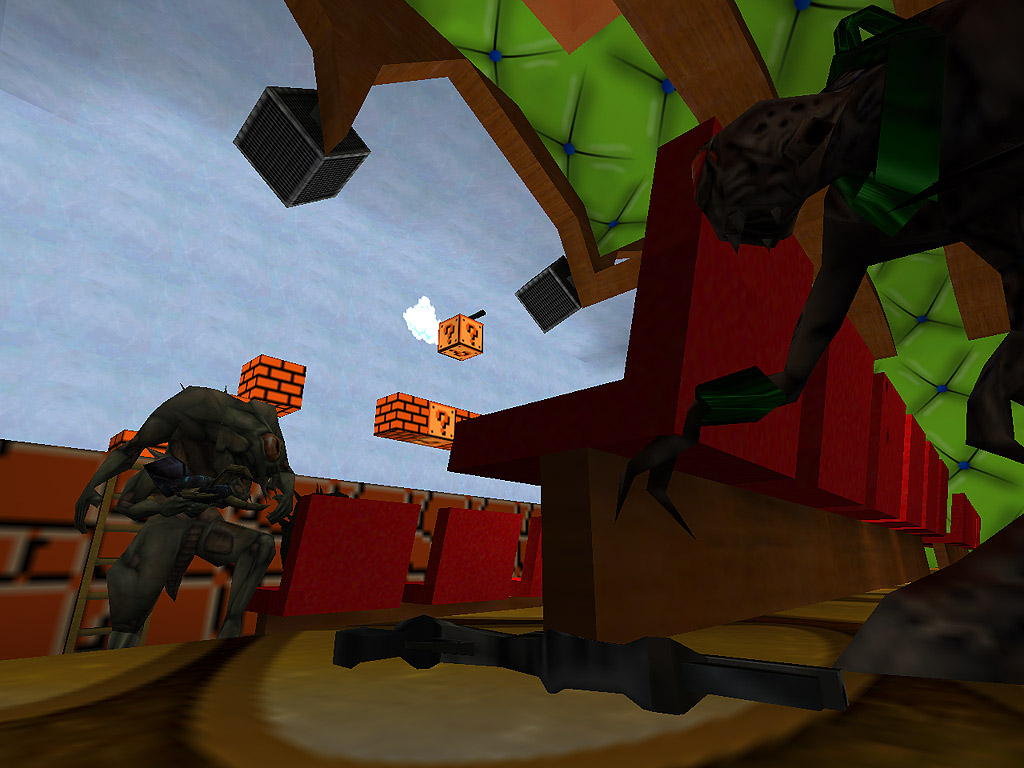
I should probably substantiate that claim. In both Mario and Half-Life, the game objective is to progress through stages by gathering items and defeating 'mini' foes. Climax scenes divide the story into levels or stages, and an over-arching narrative links these stages until the ultimate objective is reached at the end. Though these qualities that link the two games are, admittedly, pretty general, I think the narrative structures of the games, their search-and-find objectives, and the presence of goons that inhibit the main character along his path are enough to place Mario Brothers and Half-Life in a class of games that differs from others.

I think that, in various ways, people today are playing the same games that people a generation before were playing; that is, it's less often the formal elements that change from game to game than the tools we are given to reach them. This is why platform has become so important in the modern gaming world, I think; technological innovation allows the same basic game structures to take on new dimensions that turn them into what is, partly (but not essentially) a new game.

So regardless of Scog's retrophilic opinion that these five specific games are the ones that will be 'played in heaven,' I argue that the formal elements of these games are important, in the grand scheme of things, primarily as the dawn of a genre, making it possible for other games to stand on their shoulders and exist as equally, if differntly, entertaining pastimes.

Wednesday, March 21, 2007

Rectifying the Mario Shortage


I actually play a fair amout of the original SMB in my spare time to de-stress while writing papers or studying. The other night, as I was hopelessly stuck on level 6, I decided to break the monotony and try to find some cheats or something. I was expecting a simple ↑ ↑ ↓ ↓ ← → ← → B A select start or something, but what I found instead was a world of possibilities that ranged from simple cheats to game glitches that can be used to get Mario into all kinds of trouble I never knew was possible.

Pardon my ignorance, everyone who knows this already (I imagine some of you are probably going to say,' yeah, I figured that out.... when i was four."), but there is a never-ending water world at the end of 1.2!! This, to me, was remarkable. Not merely the fact that I've been playing Mario since I was in diapers (practically) and never knew about this, but that even now, there's interest in what this world is, what Mario can do in it, and whether it has any additional relevance to the game experience beyond diversion.

The never-ending water level, or "minus world" as most sites refer to it, brings up some new (well, if you're me) questions about paratextuality and canonicity in a franchize that is already so richly endowed with possibilities for interpretation. For example, can a portion of a canonical paratext be considered an epitext, and, if so, can external epitexts be considered more canonical than those internal ones?

We discussed with Myst that you can go though the entire game without really addressing the narrative exposition in the video content. Similarly, in SMB, you can play the game for, like, 20 years without ever addressing -1. And, in truth, you wouldn't be missing much narratively because, apparently, there's no way to leave it once you get in short of restarting. (Only one person has ever claimed to have completed the minus level, but he or she is largely regarded as a scammer.) Still, the presence of the minus world and other glitches of this nature have found a place in the game experience, particularly with the types of people who are attracted to cheat codes and other, more intentional secrets embedded in a game.

In fact, it appears that the minus world and the turtle of infinite life in 3.1 have survived editing, making it onto SMB for wii among other reincarnations. Yet I've found no indication that there has been any attempt to complete the minus level, to encode a destination at the end of it so that it doesn't loop, or to fix the "infinite" life trick in 3.1 so that it doesn't eventually game over (as it did in the original game after 128 1ups). That is, even though the glitches was almost certainly not intended for the final version of the game, the editors have kept them upon revisitation, and in so doing have acknowledged them as part of the Mario canon.

Still, I feel like there is a division between the type of experience in the minus world and that which takes place in normal gameplay that warrants their seperation. I would say that the minus world can indeed be considered epitextual, even though it is contained on the same physical device as the proper game and can be accessed through an exploitation of SMB's glitches. And if this is the case, I believe other texts with similar issues can be regarded in the same way, since physical location does not seem to be a determining factor of canonicity, even if that physical location is embedded within a canonical object.

Thursday, March 8, 2007

A Wii-Markably Unscholarly Post About My New Favorite Thing

(Pardon the pun. I couldn't help myself. Really.)

My sister got a Wii a couple of weeks ago, and I tried it for the first time today.

Now, I know this is supposed to be a scholarly blog, and I usually do my best to comply with that guideline, but this entry is going to contain very little substance. None, in fact. I'm sorry, and I'll do better next time, but this has to be said:

Wii might be the coolest toy ever.

I played just about everything available to me, and it's really great because I kicked all kinds of ass at bowling and baseball and boxing and everything. I threw strikes all over the place, and KOed every person who crossed my path, and pretty much wiped the floor with my sister. Not that I dont usually, at most things in fact, but it was still really cool to confirm that I could take her virtually, as well as literally.

Anyway, Wii was some of the most fun I've had in a long time. There was an article in the Red Eye last week about how people play this system so much they loose serious weight, and I totally get why. If I didn't have a million other things to do, I'd Wii-exercise (Wii-xercise?) like crazy.
Every day, probably. First I'd do 30 minutes of DDR (the only other videogame pheonomenon I've subscribed to in my adult life), then I'd switch gears to Wii Sports for another 30 to pound homers out of the park, Billy Blanks be damned. I'm confident that if we all did this, we'd all look like Giselle. Even the boys.

I remember when I was a kid and my parents got me one of those great Nintendo sports pads and I went nuts with it. Wii brings back some of those great memories of stomping my feet really hard in the same place over and over again, except with the added bonus of superior graphics and comparatively realistic sports action. I got sick of the Nintendo thing after a little while, but between you and me I'm glad that Wii belongs to my sister and not me, because let's just say I'd be doing a disproportional amont of homework for videogames class.